
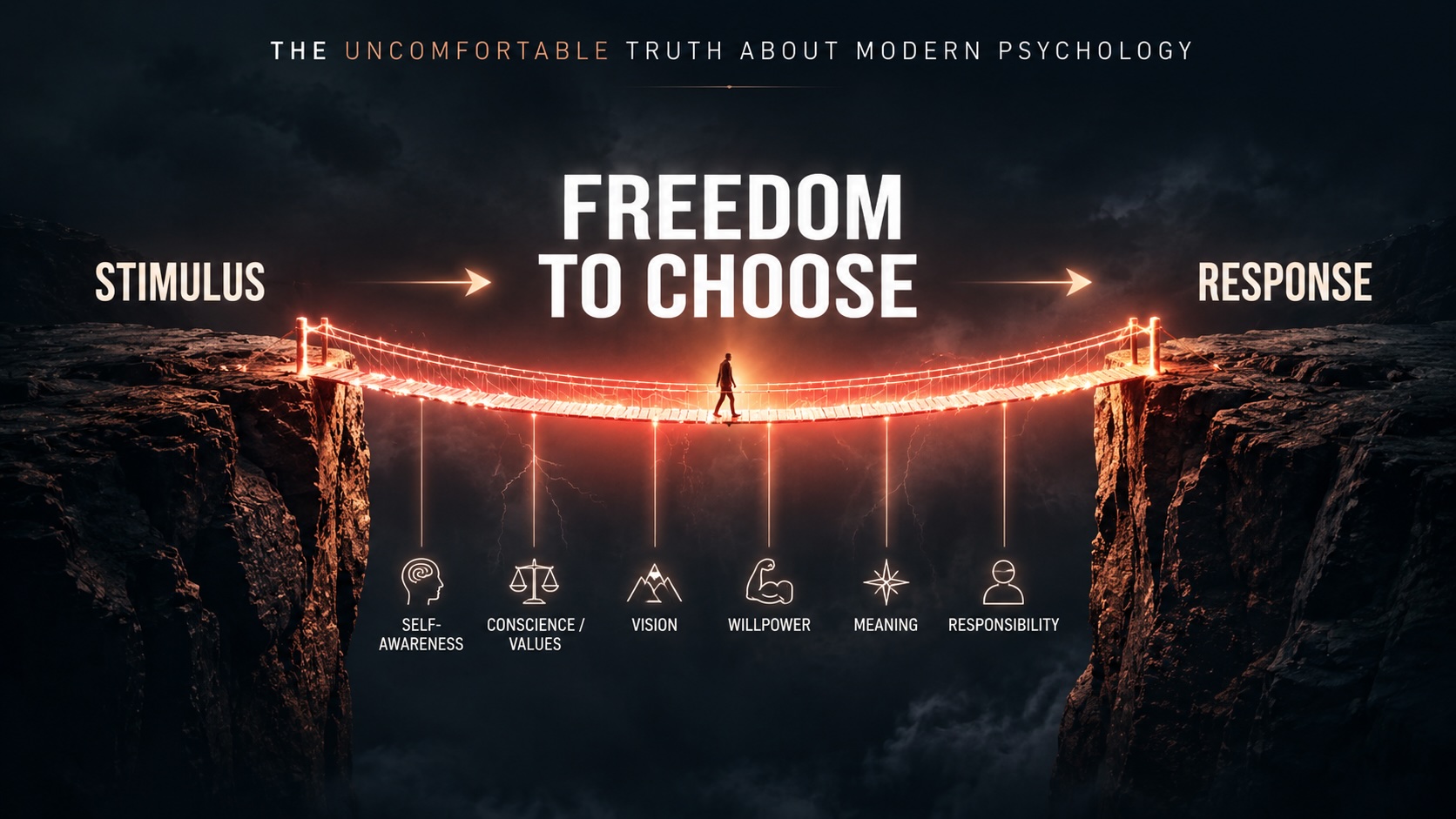
The Uncomfortable Truth About Modern Psychology
Picture this. A man walks into a psychiatrist’s office in Vienna in the 1950s. He is anxious, stressed, dissatisfied with his life. In the waiting room there is a book on the table called Man’s Search for Meaning. The author photo on the back is the man he is about to see.
That man is Viktor Frankl. The psychiatrist who survived Auschwitz.
Frankl spent years inside Nazi concentration camps watching the worst of human nature. He watched people be tortured, starved, stripped of their families, their dignity, their health. He himself was experimented on. And in the middle of that hell, he discovered the insight that would shape the rest of his career.
The one thing nobody could take from him was his freedom to choose how he would respond.
Not how he would feel. Not what would happen to him. But what he would do next. That space between what happens to you and what you do about it — that space, he wrote, is where everything human actually lives.
He built an entire school of therapy around it. He called it logotherapy. Therapy through meaning.
Now imagine sitting in that waiting room about to walk in and explain why your circumstances had defeated you.
It would be very hard.
The thirty psychologists who had never heard of him
Fifteen years ago, when I was developing my Key Habits leadership program, I sat down with thirty trained psychologists. I mentioned Frankl and asked who knew about logotherapy.
Almost none of them did.
The more I thought about it, the more I understood why.
Frankl’s model is uncomfortable. It does not just excavate your wounds. It demands something of you. It assumes you have a spine waiting to be activated, not a hurt waiting to be permanently cataloged. It puts the patient back at the center of their own life and says: The choice is yours, and it has always been yours.
That is a brutal kind of respect to offer somebody who walked in hoping to be told their suffering was inevitable.
The part nobody wants to say
Let me be careful here, because this part can land badly.
The best psychologists I have ever met treat their patients the way Frankl did — with respect, with demand, with the assumption that there is a strong person inside the suffering one, waiting to be activated. They are extraordinary. If you are in a real crisis, real trauma, real clinical territory, find one. Get help.
But the profession has a structural problem nobody likes to discuss.
It is a business. And in any business, the incentive structure shapes the practitioner.
If your model is to graduate people quickly — get them functional and resilient, taking responsibility for their own responses, walking out the door — you do not make much money.
If your model is to keep things complicated, validate forever, treat every difficulty as a wound that needs more sessions, more processing, more revisiting — the business sustains itself.
This is not a hoax. Most psychologists are not cynics. But the gravity of the field pulls in a particular direction, and over a career it pulls a lot of practitioners with it. Not all psychologists are created equal. Keep that in mind.
The other thing nobody says
There is something else going on, and it is more uncomfortable.
Many people enter the helping professions because they themselves have been suffering. That is human. Even noble at the start. You go through something hard, you want to understand it, you study it. You become a psychologist partly to figure out yourself.
The problem is what happens next.
Some of these people actually do the work on themselves. They get tested by life, build the muscle, and come out the other side as practitioners who have been there and back. Those are the great ones. They are gold.
But many do not.
Many become book-smart instead. They read everything. They take meticulous notes in three colors. They master the vocabulary, the frameworks, the diagnostic categories. They can quote the studies. From the outside, they look like someone who deeply understands the human condition.
And they have not built the skill in their own life. They have not put themselves in the situations that would test their character. They have not failed publicly, recovered, and come back stronger. They have not done the actual reps.
Here is what nobody tells you about reading without practicing.
If you only read about resilience without ever building it, the knowledge does not calm you. It makes you more anxious. Because now you are aware of every dimension of your own weakness that you have no trained skill to address. The vocabulary outpaces the capability.
That is a special kind of suffering, and a lot of people in helping professions live inside it.
It also means that when those people sit across from a patient, they cannot teach what they themselves have not built. They can analyze. They can validate. They can label. But they cannot guide somebody through the actual transformation, because they have never made the journey themselves. They are reading you the map of a country they have never visited.
This is why Frankl mattered. He had been there. The man teaching you about meaning under suffering had survived Auschwitz. The credentials were not on the wall. They were in the body.
That is the kind of teacher you want — someone who has done the thing they are asking you to do.
The numbers, honestly
We have never had more psychologists, therapists, counselors, apps, and public conversation about mental health. The infrastructure is massive and still growing.
And during the same period, mental health among young people has gotten worse. Between 2016 and 2023, diagnosed mental or behavioral health conditions among adolescents in the U.S. increased 35 percent. Diagnosed anxiety increased 61 percent. Depression increased by 45 percent.
An honest person has to acknowledge something here. Some of that rise is better detection — more screening, more willingness to talk about mental health. That is real, and it is part of the picture.
But it is not the whole picture. The vulnerability paradox in the international research shows that even countries with the most mental health resources still carry a high burden of mental disorders. More professionals, same suffering.
And anyone who works directly with young people will tell you the same thing. The kids are not just more labeled. They are more fragile. Less tolerance for discomfort. Less ability to handle being told no. Less inner resource to reach for when something hard happens.
We live in the most materially abundant, physically safe, technologically supported moment in human history. We should be doing dramatically better mentally and spiritually than we are.
We are not. Something in our approach is failing.
How to pick a psychologist if you actually need one
If you or your kid is in real clinical territory, get help. But choose carefully.
A good psychologist will push you. Will respect you enough to demand something of you. Will treat you like a person with a spine, not a wound to be permanently catalogued. Will be working themselves out of a job from the first session forward.
Look for one who has actually lived through something. Not just studied it. The lived ones speak from inside the experience. The studied ones speak from above it. You can usually feel the difference within a session or two.
There are exceptions. Severe trauma, certain kinds of grief, acute crisis, sometimes the slow, gentle approach is exactly what the moment calls for. Real clinicians know the difference between a patient who needs to be held and a patient who needs to be challenged. The problem is that the holding model is applied to everything indefinitely, regardless of whether the patient is actually getting stronger.
So pay attention. If you walk out of session after session feeling validated but not building strength, pay attention. If the model seems to require an indefinite number of appointments, pay attention. If every conversation circles back to what was done to you and never moves toward what you are going to do next — pay attention.
The deeper point
The reason we keep needing more psychologists is partly that we have stopped doing the work that used to keep most people out of the psychologist’s office in the first place.
We have stopped building character before life tests it.
We have stopped teaching young people how to handle pressure, how to take responsibility, how to sit inside discomfort, how to find meaning in a difficult moment, how to choose their response instead of being owned by it.
All of that used to be done by parents, coaches, teachers, communities, rituals, the slow accumulation of small demanding experiences that made a person into someone who could handle a hard life.
Now we strip all of that out — comfort, protection, rescue, validation — and then we are shocked when the kid arrives at twenty unable to function and needs a professional to put them back together.
Frankl’s whole point was that the work has to happen before the crisis. The freedom to choose your response is not something you suddenly discover under pressure. It is a muscle. Built. Trained. Forged through self-awareness, conscience, vision, willpower — the things that make character. Not read about. Trained.
Here is the one practical thing I will give you, and you can do it this week.
The next time your kid comes to you with a hard feeling, before you ask what you can do for them, ask them what they are going to do about it. Not in a cold way. In a respectful way. The way Frankl would have asked. What is the response you are going to choose here?
That single shift — from let me fix it to what are you going to do — is the beginning of building a person who, ten years from now, will not need a therapist for things they could have learned to handle themselves.
The work has always been upstream.
It still is.